0


Your Cart


Product title goes here
$19.95
Thank you! Your submission has been received!
Oops! Something went wrong while submitting the form.
No items found.
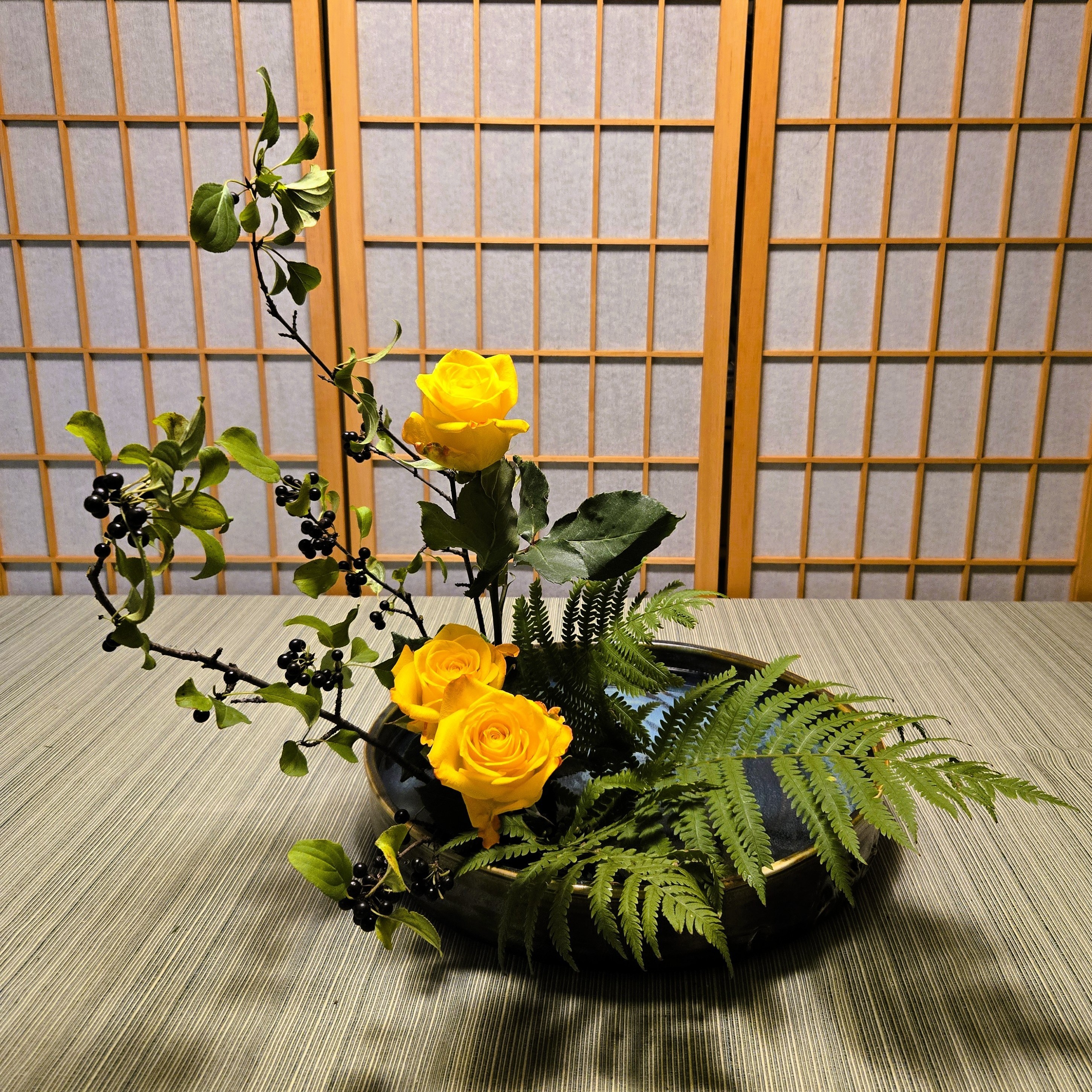
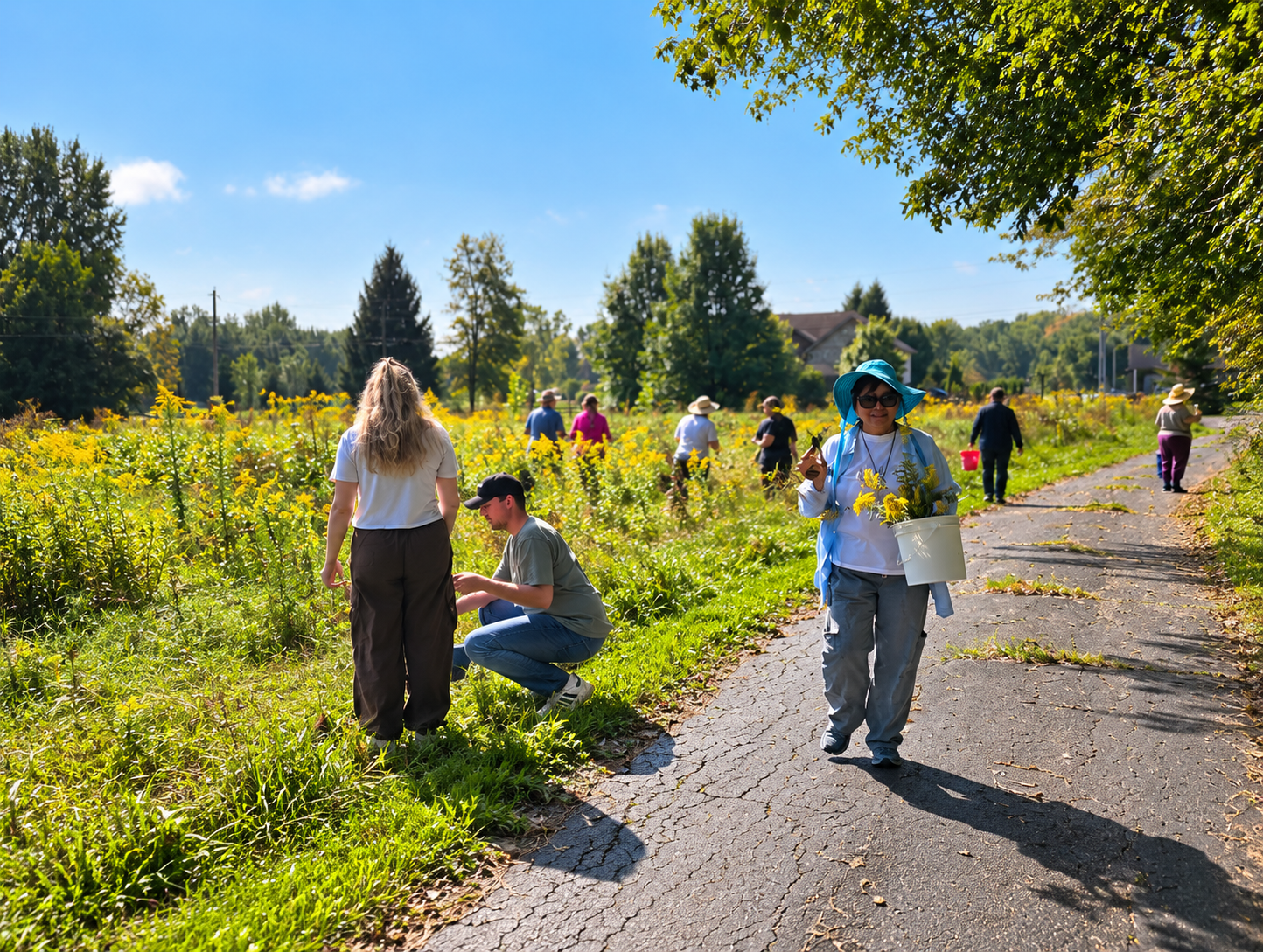
For a special September class, we took Ohara Ikebana outdoors. Students explored the landscape, selected and cut their own branch material, then discovered that choosing the right branch can be a lesson in itself.
Sometimes nature has plans of its own.
Our special September outdoor ikebana experience was originally scheduled for Saturday morning, but severe thunderstorms and heavy rain made gathering outdoors unsafe. With a quick change of plans, we moved the entire event to Sunday morning.
Fortunately, the change didn't dampen anyone's enthusiasm.
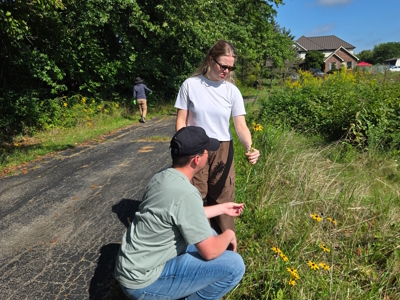
Members and guests of Central Ohio Ohara Ikebana gathered at a beautiful private property in Ostrander, Ohio, where our lesson in Moribana Slanting Style (Keisha-kei) began not with materials waiting on a table, but with a walk through the landscape.
Our first task sounded simple: find a branch you would like to arrange.
It turned out to be one of the most interesting lessons of the day.
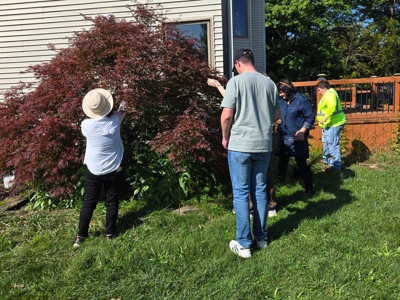
In a typical ikebana class, students receive branch material that has already been selected and cut. Someone has already made that first important decision for them.
Outdoors, the experience is entirely different.
Instead of looking at several branches on a table, students were looking at entire trees and shrubs. Which branch has an interesting line? Which one has the right proportion? What will happen when it is separated from the rest of the plant? Will the shape that looks beautiful on the tree still be interesting when viewed on its own?
Several participants commented that choosing their own material was harder than they expected.
They also loved it.
Before making a single cut, students had to slow down and really look. They began imagining a branch not simply as part of a tree or shrub, but as potential ikebana material.
In a sense, the lesson had already begun before we returned to our worktables.
There is something especially appropriate about taking an Ohara Ikebana lesson into the landscape.
The Ohara School was founded in 1895 by Ohara Unshin (1861–1916), whose development of Moribana helped usher ikebana into the modern era. The School's own history tells us that Unshin explored fields and mountains as he worked to develop a form of ikebana that could express the beauty of natural scenery. [Ohara School of Ikebana. Hana-gata Cards. Tokyo: Ohara School of Ikebana.]
Moribana itself was an innovation. Unshin sought a type of ikebana that could both make use of the colorful Western flowers becoming increasingly available in Meiji-era Japan and express the beauty of picturesque scenery in nature. His answer was Moribana, arranged in a low, shallow container called a suiban. [Ohara School of Ikebana. Hana-gata Cards. Tokyo: Ohara School of Ikebana.]
We weren't attempting to recreate a historical lesson. But walking among growing plants, observing their individual character and considering how a particular branch might become part of an arrangement gave us a small opportunity to experience the kind of close observation of nature that has been part of the Ohara School from its beginnings.
There is another wonderful connection to the way Ohara Ikebana is taught today.
In his introduction to the Ohara School's Hana-gata Cards, Fifth Headmaster Hiroki Ohara reminds students that no two materials in nature are identical. The characteristics of branches and even the way leaves are attached to a stem vary from one specimen to another. Creating ikebana therefore requires us to make the most of the particular floral materials we have in our hands. [Ohara School of Ikebana. SOKA, No. 897, August 2025. Tokyo: Ohara School of Ikebana.]
Our outdoor lesson made that principle unusually tangible.
There wasn't a bucket containing a collection of similar branches from which everyone could choose. Each student returned from the property carrying something different, with its own line, growth habit, leaves, imperfections and possibilities.
The challenge then became:
What can I do with the branch I chose?
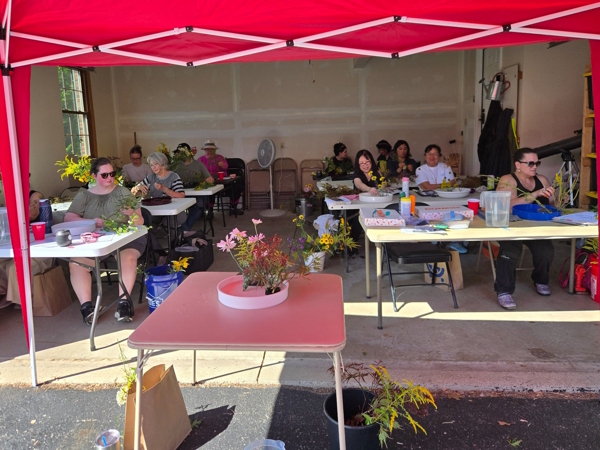
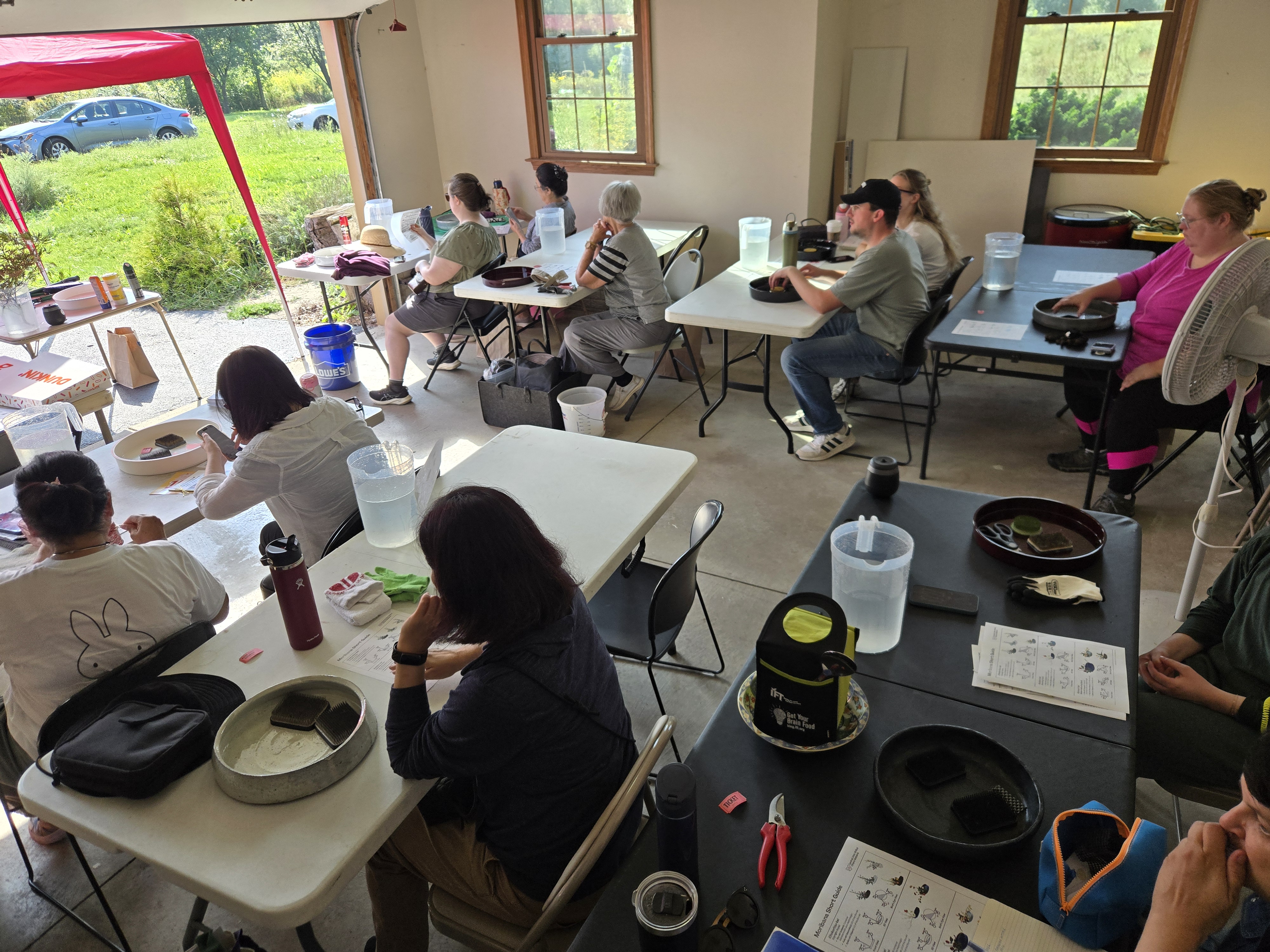
With our branches gathered, everyone returned to the work area for our lesson in Moribana Slanting Style (Keisha-kei).
In the Ohara School, Moribana is arranged in a low, shallow container called a suiban, and Slanting Style is one of its three principal styles. [Ohara School of Ikebana. Hana-gata Cards. Tokyo: Ohara School of Ikebana.]
Students reviewed the structure of the arrangement and then began working with the material they had personally selected.
Choosing the branch themselves seemed to change the experience in an interesting way. Rather than beginning with, What am I supposed to do with the branch I was given?, students had already spent time studying their material before bringing it to the arranging table.
Of course, nature doesn't necessarily hand us the perfect branch.
There were decisions to make, unnecessary growth to remove, angles to reconsider and, occasionally, an original idea that needed to be abandoned completely.
In other words, it became ikebana.
After everyone completed their arrangements, we gathered for critique, looking not only at how each person had interpreted Slanting Style, but also at the very different ways the materials discovered around the property had been used.
Once the arrangements were finished and critiques completed, it was time for another important part of our special September gathering: lunch!
Everyone contributed to a potluck, with meatball sandwiches as the centerpiece and participants bringing sides, desserts and drinks to share.
The potluck turned out to be more than simply something to eat after class. It gave everyone a chance to linger, talk about the morning, compare experiences and simply enjoy being together.
Ikebana may bring us together around flowers, but a Chapter is also built through friendships, conversations and shared experiences. Sometimes those happen while standing over a suiban.
Sometimes they happen over a plate of food.
Both matter.
An experience like this is only possible because someone is willing to open their space to others.
We are tremendously grateful to our hosts, Corrinne and Lindsey, for welcoming Central Ohio Ohara Ikebana to their beautiful property and allowing us not only to enjoy the landscape, but to walk through it with clippers in hand and select material for our arrangements.
Their generosity gave us an opportunity to experience our materials in a way that simply isn't possible in our regular classroom setting.
We're also grateful to everyone who adapted so quickly when Saturday's weather forced us to change plans. Moving an entire event by a day isn't easy, and we appreciated everyone's flexibility and enthusiasm.
Judging by the conversations during lunch and afterward, this may be an experience we'll have to repeat.
What began as a different way to hold an ikebana class became a reminder of something fundamental to our art:
Before we arrange nature, we have to see it.
Joe Rotella
Associate Second Term Master
Ohara School of Ikebana