0


Your Cart


Product title goes here
$19.95
Thank you! Your submission has been received!
Oops! Something went wrong while submitting the form.
No items found.
This article explores the meaning behind Water-Reflecting Moribana, looking at how Ohara’s Japanese terminology emphasizes perception over action. By examining language, history, and practice, it offers a deeper way of understanding the role of water in Moribana arrangements.
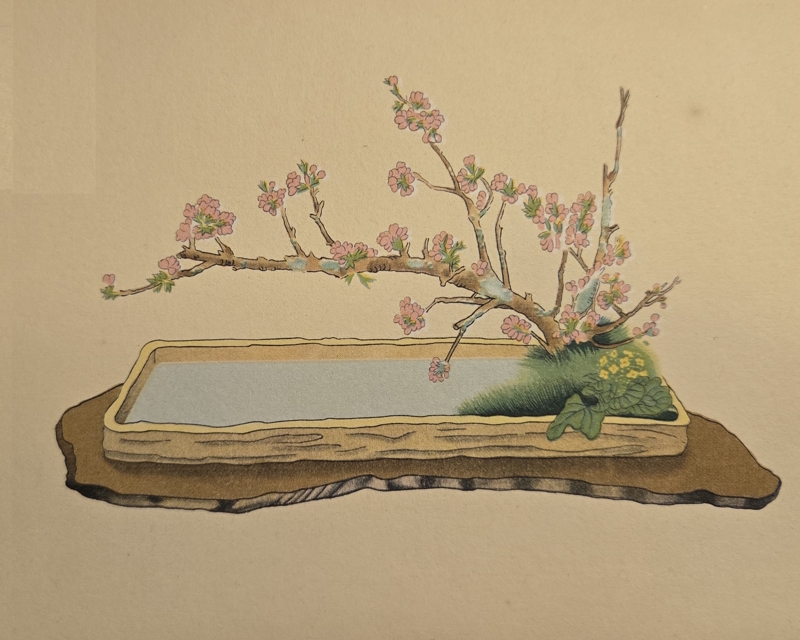
Every so often, a thoughtful question from a fellow Ohara practitioner opens a door you did not realize you wanted to walk through.
Recently, a question came up about the “water-reflecting” Moribana style. Specifically, why Ohara names it the way it does, and why the Japanese terminology does not seem to say “reflection” at all.
It turns out that question leads somewhere much more interesting than translation.
In English, we tend to describe things by action. Water reflects flowers. Light reflects off the surface. The emphasis is on cause and effect.
Ohara does not frame it that way.
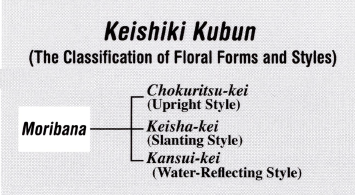
The Japanese term used is 盛花観水形 (Moribana Kansui-kei). A very literal reading would be something like “Moribana viewing-water form,” which the Ohara School refers to in English as the Water-Reflecting Style.
The character 形 (kei) refers to a form or an established configuration. The word 観 (kan) means to view, observe, or contemplate. 水 (sui) is water, but here it appears in a Sino-Japanese compound rather than as the everyday word mizu. That shift matters. We are no longer talking about physical water. We are talking about water as an idea.
This style is not named for what the water does. It is named for how we are meant to see.
In Water-Reflecting Moribana, water is not background. It is not empty space. It is not something to be hidden or minimized.
Water is part of the composition because it changes perception.
Depth, distance, stillness, and quiet movement all live on the water’s surface. The flowers are not simply placed in front of it. They are experienced through it.
Seen this way, reflection is implied rather than stated. The water does not need to “reflect” as an action. The viewer completes that experience by looking.
This way of naming things is very Japanese, and very Ohara.
Curiosity got the better of me, so I went back to the oldest Ohara text in my library, originally published in June 1934.
By that time, Moribana was already central to the school. It was being taught systematically, but the terminology had not yet hardened into the fixed labels we use today. Everything fell under the broad heading “Ohara School Flower Forms,” referring to formalized shapes or established configurations based on the Japanese concept of 形 (kei).
What is striking is that even then, water was already treated as something to be viewed, not merely filled around. The thinking was in place long before the naming fully settled.
Looking through early Ohara instructional materials, you can already see this way of thinking in practice. Even before “Water-Reflecting” appears as a named style, arrangements emphasize exposed water surfaces, low placement, and lateral movement that invite the viewer to look through the water rather than past it.
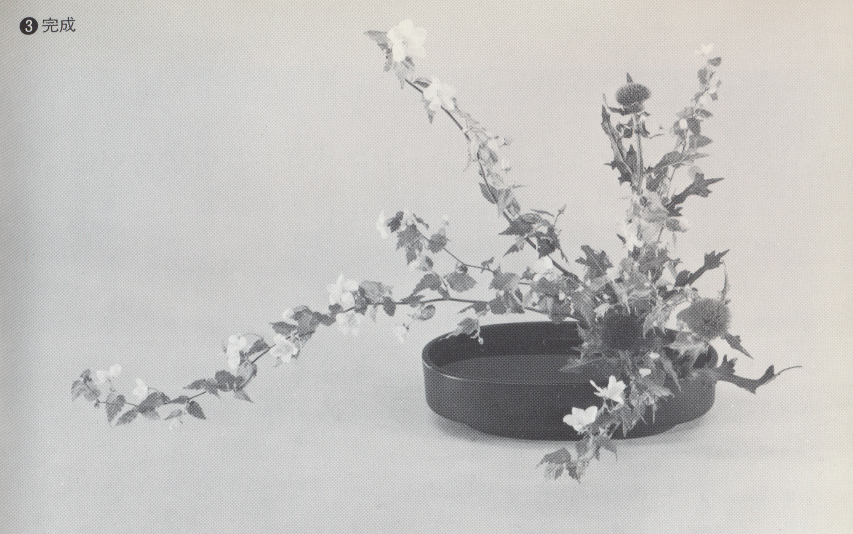
In other words, the idea came first. The label followed.
That continuity is one of the quiet strengths of Ohara. What we practice today is not a reinvention. It is a refinement.
If we think of Water-Reflecting Moribana as simply another structural variation, we miss its point.
This form asks us to slow down. To pay attention to how depth is perceived. To allow empty space to carry meaning. To let water do its subtle work without forcing it to perform.
Other Moribana forms express space, direction, or movement.
Water-reflecting begins with perception.
Joe Rotella
Associate Second Term Master
Ohara School of Ikebana


