0


Your Cart


Product title goes here
$19.95
Thank you! Your submission has been received!
Oops! Something went wrong while submitting the form.
No items found.
What began as an opportunity to teach Ohara Ikebana in Columbus grew quickly into a community of students, friends, and practitioners. Looking back at the records from 2023 and 2024 reveals how Central Ohio Shibui took root and became an official Ohara School Study Group.
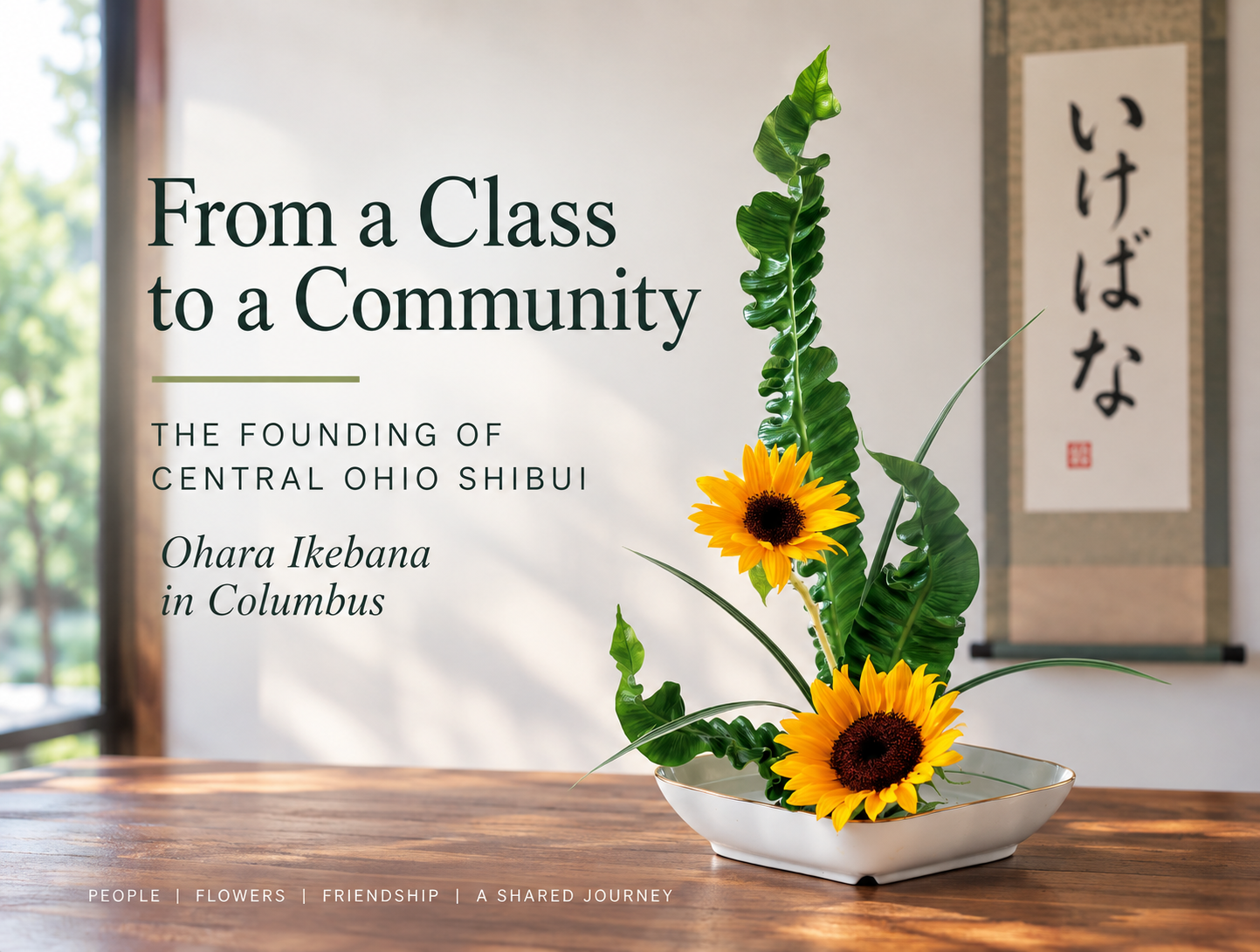
Sometimes the beginning of something important is only obvious when we look back.
Central Ohio Shibui Ikebana officially became an Ohara School Study Group on November 1, 2024. But its story began earlier, with a teaching opportunity, a new home for classes, and the belief that there was room for a stronger Ohara Ikebana community in Central Ohio.
In late 2023, Asian American Community Services (AACS) approached Joe Rotella about offering ikebana instruction to its clients and introduced him to the Yokoso Center at Japan Marketplace in Columbus.
For Joe, who had begun studying Ohara Ikebana in 1993, the opportunity offered a way to share an art that had been part of his life for three decades.
By December 2023, plans were taking shape. An agreement had been finalized to offer lessons and demonstrations at the Yokoso Center. A regular schedule was established for the second Saturday and third Wednesday of each month, organizational roles were being developed, marketing materials were created, and relationships with floral suppliers were established.
The pieces were in place. It was time to see whether anyone would come.
Regular classes began in January 2024 with Rising Form.
From the beginning, the goal was to make Ohara Ikebana approachable even for someone who had never arranged flowers before. Students could come without owning specialized equipment. Containers, kenzans, clippers, buckets, and other supplies were made available so that a newcomer could simply arrive and begin learning.
The response quickly demonstrated that there was an appetite for ikebana in Central Ohio.
As the months progressed, students moved from Rising Form to Inclining Form, then into Moribana Upright and Slanting Styles and other areas of the Ohara curriculum. What had begun as a series of classes was gradually becoming a community.
At almost exactly the same time, ikebana received some unexpected local attention.
The Spring 2024 issue of 614 Refined featured Joe and his ikebana practice in an article titled “The Contemplative Art of Ikebana.” The article explored both the aesthetics of ikebana and the experience of practicing it.
For Joe, one of ikebana's attractions was the contrast it provided to a workday dominated by technology. In the article, he described leaving behind email and digital work for something tactile: branches, flowers, scent, shape, and the experience of creating with natural materials.
That idea remains central to the experience we hope students find in our classes today. Ikebana asks us to slow down, observe carefully, work with nature rather than simply control it, and appreciate what is in front of us.
The new classes also began reaching beyond Yokoso Center through demonstrations and community programs. Central Ohio Shibui was becoming not simply a place to study arrangements, but a way to introduce more people to Ohara Ikebana and Japanese culture.
Another important milestone arrived in April 2024 when the Ikebana Iwaya Fund awarded a $5,000 Innovation Challenge Grant to support the group's educational and community activities.
For a new organization, that support was significant. It helped make it possible to think beyond individual classes toward building something sustainable.
By May, work had also begun on a website to help people discover Ohara Ikebana classes and activities in Central Ohio.
The roots were spreading.
The summer brought an especially meaningful event.
In August 2024, Joe's teacher, Kiyoichi Kamo (Kamo-sensei), came from Japan to Columbus. During his visit, he conducted a workshop with two lessons for 20 participants and presented a public demonstration attended by 91 people.
For students who had only recently discovered Ohara Ikebana, it was an extraordinary opportunity to experience the School through a highly accomplished Japanese instructor. For more experienced practitioners, it was an opportunity for deeper study.
And for a community that had begun with regular classes only months earlier, nearly one hundred people gathering for an Ohara Ikebana demonstration offered striking evidence that something was taking root.
By the fall of 2024, the idea of becoming an official Ohara School Study Group was no longer merely aspirational.
The membership list prepared for the application contained 30 people, ranging from experienced Ohara practitioners to students just beginning their studies. The group now had regular classes, officers, educational and community activities, and a growing body of students interested in pursuing the Ohara curriculum.
Then came the letter from Japan.
Dated November 1, 2024, the letter from Ohara School Headmaster Hiroki Ohara formally granted permission to organize the Central Ohio Shibui Study Group of the Ohara School of Ikebana in Ohio, USA, for the term beginning November 1, 2024.
But the Headmaster's message went beyond official recognition.
He asked that members study not only ikebana techniques, but also “deepen friendship among the members through ikebana.” He expressed his hope that the new Study Group would contribute to society by promoting understanding and goodwill between Japan and the United States.
Those words captured remarkably well what had already begun to happen.
In less than a year, a teaching opportunity had become something much larger.
People who might never otherwise have met were gathering around buckets of branches and flowers. Beginners were discovering Moribana. Experienced practitioners were sharing what they knew. Students were beginning formal study within the Ohara School. Visiting instructors were bringing new perspectives. And friendships were forming along the way.
The Headmaster's letter gave the new Study Group official recognition, but perhaps more importantly, it gave voice to its purpose.
Study the art.
Share it with others.
Deepen friendships through ikebana.
And use something as seemingly simple as arranging flowers to create greater understanding between people and cultures.
On November 1, 2024, Central Ohio Shibui became an official Ohara School Study Group.
But by then, it had already become a community.


