0


Your Cart


Product title goes here
$19.95
Thank you! Your submission has been received!
Oops! Something went wrong while submitting the form.
No items found.
How does a tradition evolve without losing its foundations? Explore the history, philosophy and possibilities of Mizukagami no Kei.
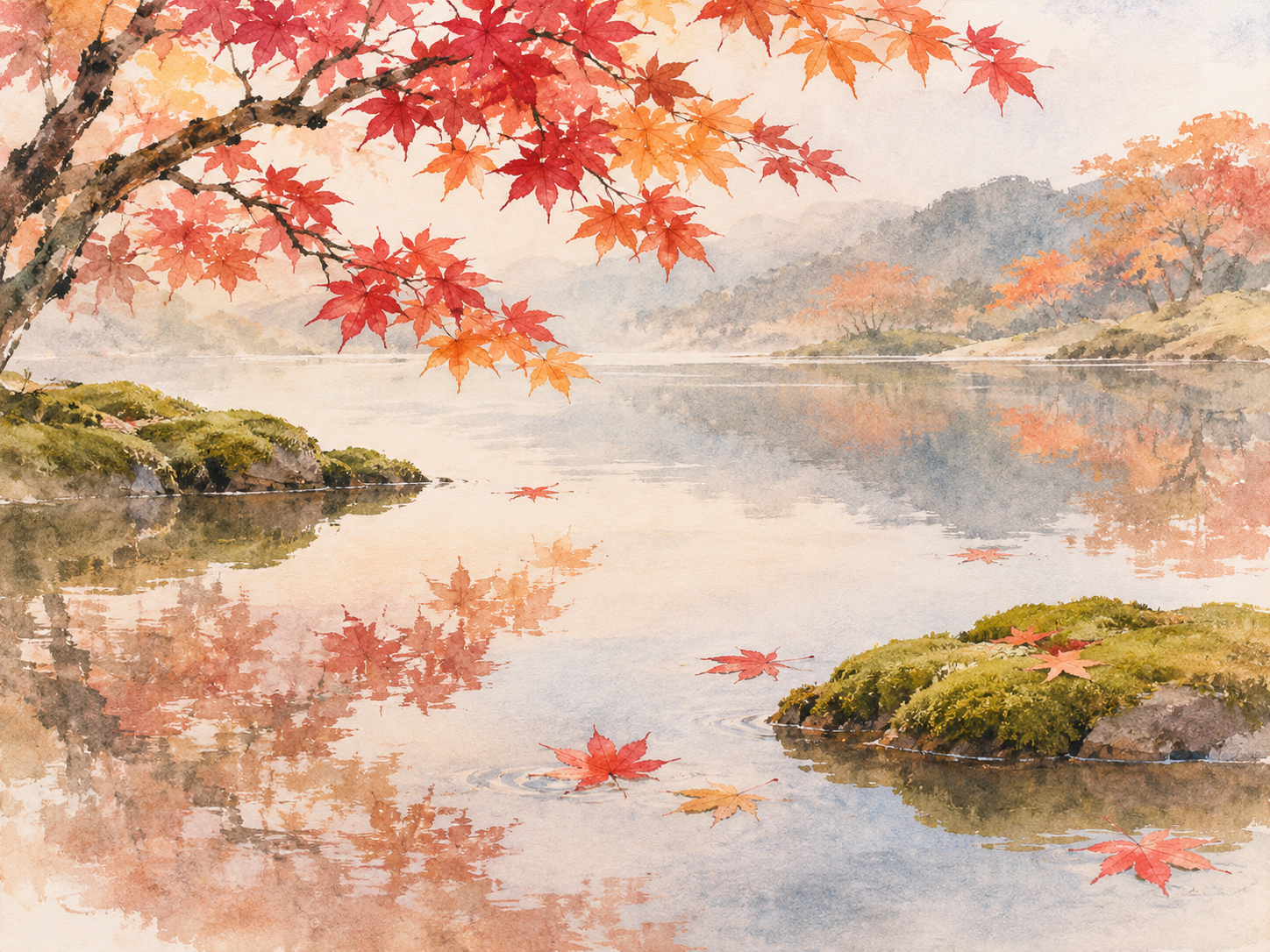
On November 27, I spent an evening studying the Ohara School's new online seminar on Mizukagami no Kei (水鏡の景). After more than three decades of studying Ohara Ikebana, I still find it exciting when something challenges me to look at nature in a different way.
Mizukagami no Kei belongs to Shakei Moribana Yoshiki Hon-i (Landscape Moribana, Traditional Method). Its name evokes the image of water as a mirror. What interests me most is not simply the introduction of a new arranging method, but the thinking behind its development: how can we carry the essential foundations of Ohara Ikebana into the future while making them more approachable?
This article shares my personal reflections on the School's published educational resources and recent seminar, rather than offering formal instruction in the method.
Water and land have long been central to the Ohara School's expression of natural scenery. The January 2026 issue of Ohara School, Ikebana Ohara-ryu Soka (小原流挿花) documents a fascinating historical connection. On page 12, a photograph of an arrangement by founder Unshin Ohara is identified as the prototype for Chiri Momiji (Scattered Maple Leaves). Although ground cover was not used in that early work, the extensive water surface and mountain chrysanthemums suggest the presence of land.
The established Chiri Momiji arrangement has a poetic theme: maple leaves carried downstream reveal that the leaves in the mountains have changed color. Ground cover at the back suggests the opposite shore. The landscape extends, in the imagination, well beyond the boundaries of its container.
Mizukagami no Kei develops a relationship that has been explored since the School's founding.
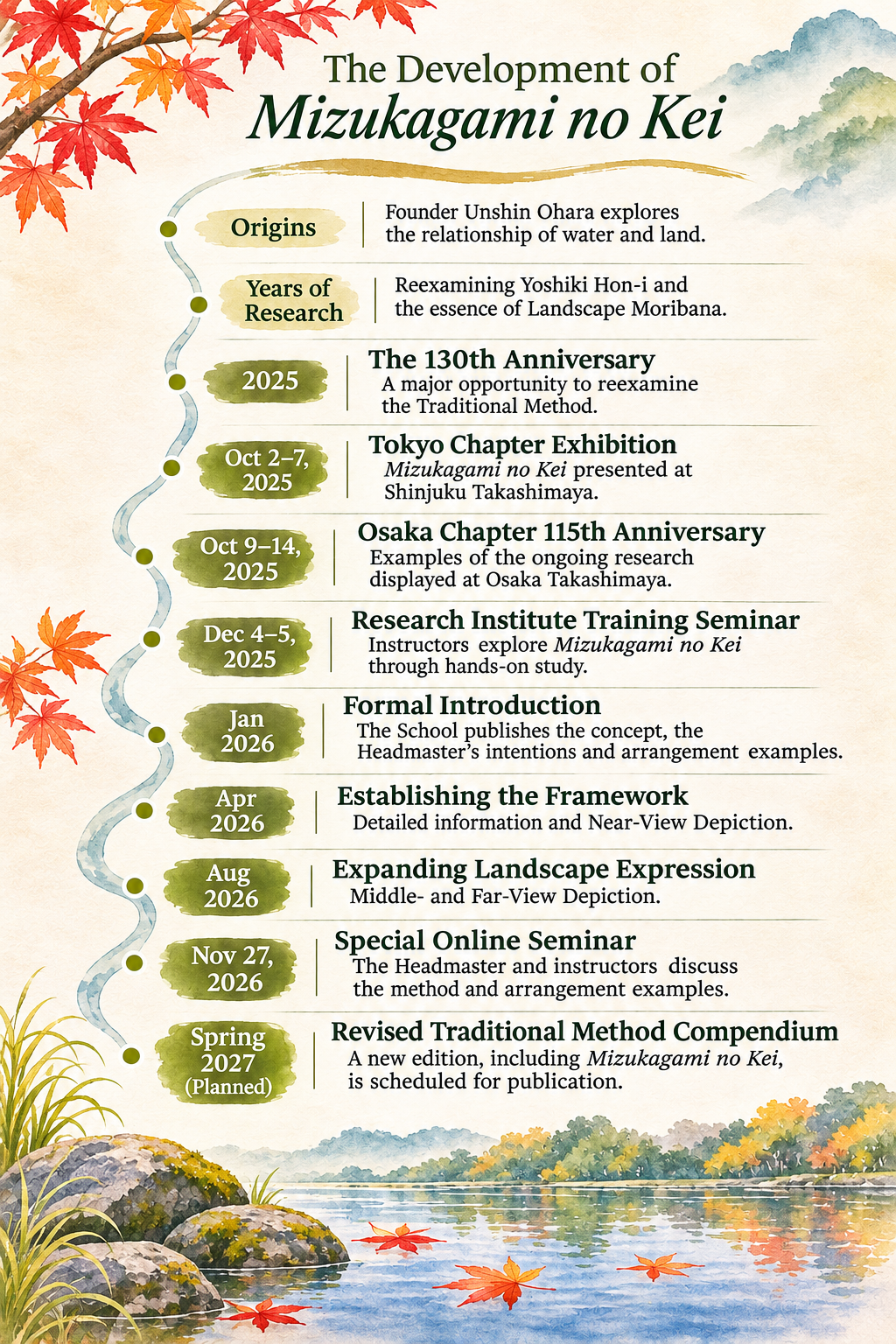
In the January 2026 feature, Fifth Headmaster Hiroki Ohara describes several years of research with Research Institute instructors into the essential elements of Landscape Moribana. The School's 130th anniversary in 2025 provided an opportunity for a substantial reexamination of the Traditional Method.
Examples of Mizukagami no Kei were being presented at the Tokyo Chapter exhibition at Shinjuku Takashimaya, October 2–7, 2025. The Osaka Chapter's 115th anniversary exhibition, October 9–14, also featured displays related to the reexamination of Yoshiki Hon-i. On December 4–5, Research Institute instructors explored the method at their training seminar. These activities are documented on pages 16–17 of the January issue.
The January 2026 issue formally introduced the method and its conceptual foundations. The April feature introduced its regulations (規定, kitei), and the August feature continued the discussion with Middle- and Far-View Depiction. The November 27 online seminar brought together the Headmaster and Research Institute instructors to discuss its development, characteristics and arrangement examples.
The opening of the Headmaster's discussion in the January issue expresses a desire to make Yoshiki Hon-i more approachable. He explains that the intention was not to reject the Ohara Ikebana practiced until now, but to identify its most important elements and consider how to carry them into the future.
He describes a challenge familiar to many teachers and students. Beginners may become so occupied with remembering arranging techniques, and teachers with conveying them, that there is little opportunity to explore the reasons behind the prescribed forms.
Prescribed forms have a purpose: to help us express the natural growth habits and appearance of materials. If our attention becomes concentrated on the form itself, we risk overlooking the landscape it is meant to evoke.
The Headmaster also discusses changes in the availability of plant materials. In the broader reexamination of Yoshiki Hon-i, the selection of new principal materials considers both their natural character and whether they can be obtained on a continuing basis. The forthcoming revised compendium is being developed with greater emphasis on mastery of arranging methods rather than predetermined plant materials.
For me, learning a form is important, but understanding its purpose can make the experience much richer.
Imagine standing beside a quiet stream. Plants grow at your feet. Across the water, branches extend toward the light. Farther away, trees rise above the bank. The water might reflect their forms, or fallen leaves might suggest the changing season somewhere upstream.
In Landscape Moribana, the environment is not simply a backdrop for the flowers. The January feature explains that the sense of landscape arises from both the handling of plant materials and the creation of an environment. Mizukagami no Kei places particular emphasis on the relationship between water and land.
Ground cover, or Shitagusa, represents land, while the uncovered area of the suiban represents water. Their contrast helps establish the environment. What I find especially appealing is that open space can carry meaning in its own right. It can suggest a stream, the expanse of a pond, or the distance between two banks.
The November seminar identifies three characteristics of Mizukagami no Kei. In my own words, these are a compositional framework based on flower styles and Principal Stems; regulations (規定, kitei) supporting the expression of scenery through the relationship between water and land; and the use of Near-, Middle- and Far-View Depiction.
These characteristics help explain why the method belongs within Yoshiki Hon-i even though it provides scope for individual expression.

The seminar presents eight regulations (規定, kitei). Rather than reproduce the technical instructions here, I find it helpful to think about the artistic questions they address: the establishment of land and water, the choice of flower style, perspective, relationships among plant materials, asymmetrical composition, compactness and scale, flexibility within established angles, and the relationships among the materials of the Principal Stems.

The framework does not prescribe one finished appearance. It provides a basis for developing the landscape the arranger has envisioned. Nor does greater freedom in material selection mean that any combination is appropriate. Natural growth habits, seasonality and the environment being depicted remain important considerations.
Readers wishing to learn the actual regulations should consult the School's educational materials and their instructors.
The January examples and November seminar demonstrate how different kinds of scenery can be expressed. Near-View Depiction emphasizes herbaceous flowering plants and familiar scenery close at hand. Middle-View Depiction explores the appearance of shrubs, while Far-View Depiction can evoke groves, rows of trees and more distant scenery.
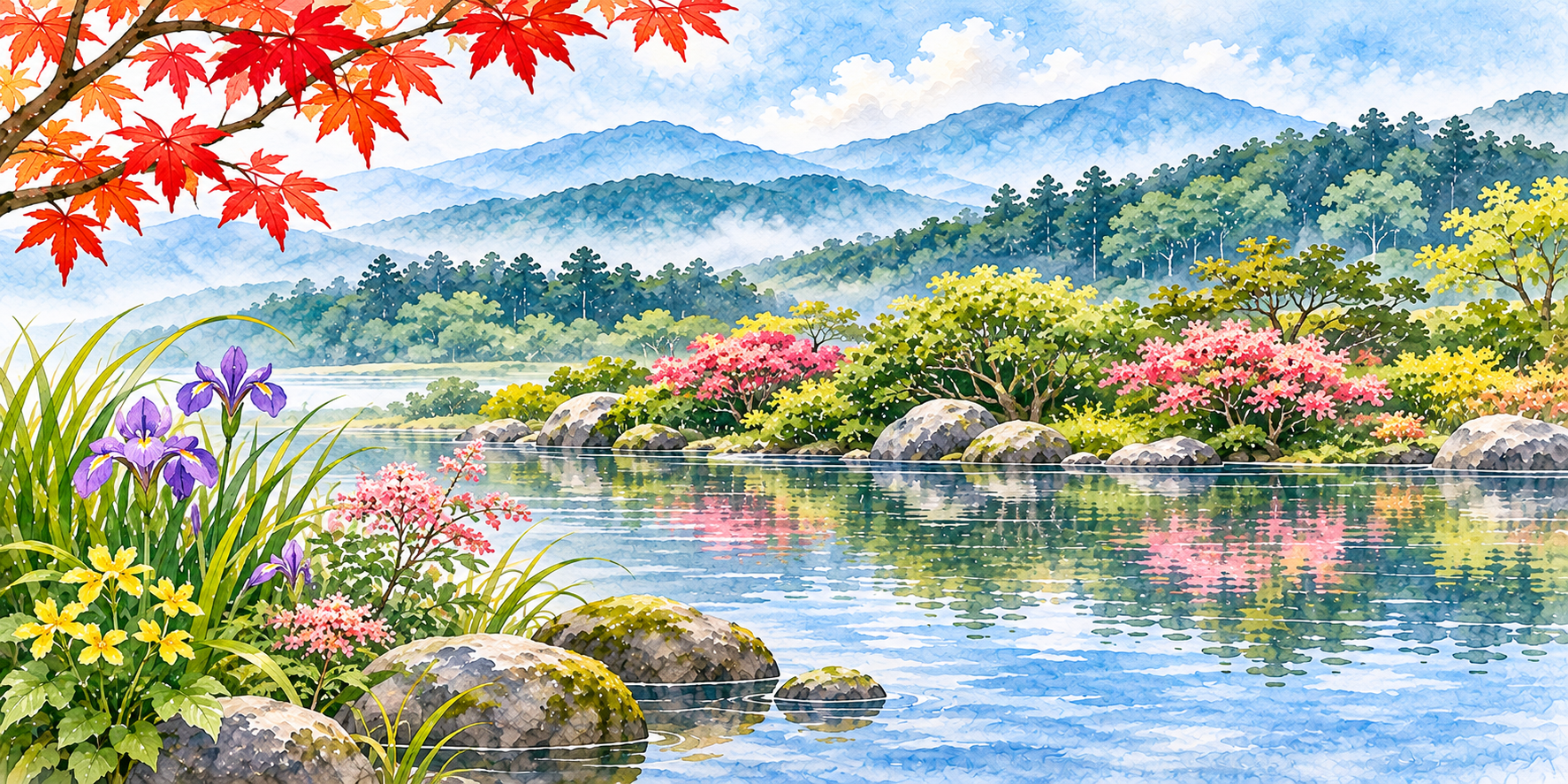
Think again of that stream. Looking down, you might notice a small flower emerging beside the water. Looking across the stream, you notice shrubs on the opposite bank. Looking farther away, your attention moves to trees. Each view offers a different experience of the same environment.
To me, perspective is about more than the relative size of materials. It is about deciding what part of the landscape we want the viewer to experience.
The seminar also distinguishes ground cover from undergrowth (Shitabae), which helps connect the principal plant materials with the vegetation representing the ground. This draws attention to the transitions in a landscape, rather than only its most prominent flowers.
One of the most interesting passages in the Headmaster's January discussion concerns the value of failure. He encourages practitioners to take on challenges without fearing mistakes, and describes the deeper understanding that can come from trying again successfully. He also expresses a hope that teachers and students will work together to consider how arrangements can be improved, rather than simply judging them as correct or incorrect.
At the time of that publication, he noted that aspects of Mizukagami no Kei were still being examined, even within the Research Institute. He acknowledged that Yoshiki Hon-i had undergone smaller changes over the years and anticipated that this method would also develop through practice.
That is an observation about the state of the research in January 2026, not a claim that particular regulations remain unsettled today.
For those of us studying Ohara Ikebana outside Japan, the discussion of plant availability is especially interesting. Here in central Ohio, streams, ponds, woodland edges and gardens offer abundant opportunities to observe the relationships among plants, water and land.
The plants available to us may differ from those available in Japan. But we can observe how vegetation grows together, how the colors of evergreen and deciduous plants differ, and how sunlight and shade change the appearance of a shoreline. Those observations can enrich our appreciation of landscape expression. This is an invitation to observe nature, not a recommendation that particular local substitutions have been approved by the School.
The November seminar announces continuing educational examples during 2027 and a revised compendium of the Traditional Method planned for spring 2027. I am looking forward to studying these resources and learning more under my teacher's guidance.
What excites me about Mizukagami no Kei is the connection between the School's long history and its willingness to examine how that history can be carried forward. The next time you walk beside a pond or stream, take a moment to notice where the water meets the land, what grows there, and how your view changes as you look farther away. There is always something more to discover.
The official special online seminar on Mizukagami no Kei features Fifth Headmaster Hiroki Ohara and Research Institute instructors discussing its background, intentions and characteristics, accompanied by arrangement examples and commentary.
Viewing period: November 27, 2026 through January 29, 2027, at 4 PM Japan time (2 AM Eastern). Tickets may be purchased until one hour before viewing ends. The listed price is ¥2,000, and one ticket permits repeated viewing during the access period. The seminar is presented in Japanese and runs approximately 28 minutes.
Visit the official seminar registration page on Peatix.
For official publications and announcements, visit the Ohara School website or Hanamore, the School's online store.
About this article: Japanese-language sources were studied with the assistance of AI transcription and translation tools. This independent editorial feature reflects my understanding of the published materials and is not an official translation, authorized interpretation or substitute for instruction. The illustrations, created with the assistance of AI, are original conceptual artwork, not reproductions of the School's photographs or instructional diagrams.
Joe Rotella
Associate Second Term Master
President, Central Ohio Shibui Ohara Chapter
Ohara School of Ikebana
Whether you live in Central Ohio or across the world, you can be part of our Ohara ikebana community. Annual membership is just $24 and includes four online lectures each year (a $60 value), available live or on demand.
Become a Member →Near Columbus? Join us in person for beginner-friendly Ohara ikebana classes.
View Columbus Classes →