0


Your Cart


Product title goes here
$19.95
Thank you! Your submission has been received!
Oops! Something went wrong while submitting the form.
No items found.
What do spectacular chrysanthemums in Tokyo and our November Ikebana lessons in Columbus have in common? An unexpected conversation with an Ohara friend visiting Japan reveals a fascinating connection between two Japanese art forms that celebrate the beauty of cascading plants.

Sometimes the most interesting connections happen when you least expect them.
I recently called my friend Lorian, President of the Victoria Ohara Study Group in Canada, and was surprised to discover she was in Japan! She had traveled there to attend the Ohara World Seminar and was preparing to head home.
During her visit, she had explored the Chrysanthemum Exhibition at Tokyo's Shinjuku Gyoen National Garden. She generously sent photographs of spectacular chrysanthemums cascading downward, enormous domes of flowers, and extraordinary blooms unlike those we usually encounter in our local flower shops.
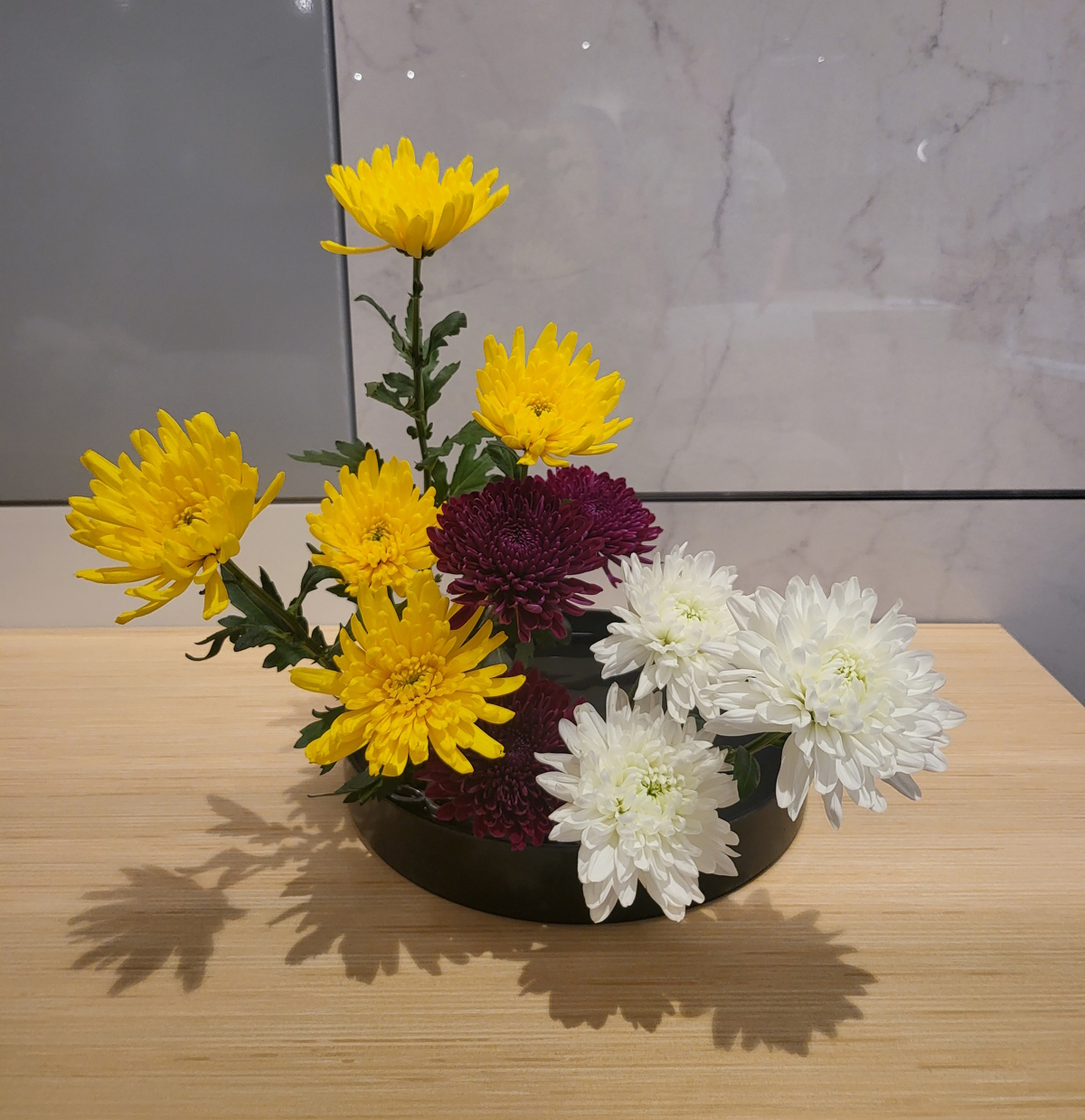
The timing couldn't have been more appropriate. This November, our students in Columbus are studying Heika Kasui-kei (Cascading Style), an Ohara School style in which plant materials descend from a tall container.
And here was Lorian, halfway around the world, sharing photographs of a different Japanese art form that also celebrates the beauty of cascading plants. The techniques are very different, but the visual connection was impossible to miss.
Each November, Shinjuku Gyoen National Garden presents a remarkable exhibition of chrysanthemums in its Japanese Traditional Garden. In 2026, the exhibition ran from November 1 through 15.
Its history begins in 1878, when the Imperial Household Ministry held a chrysanthemum-viewing event for the Imperial Family at Akasaka Palace. Foreign envoys were invited beginning in 1880. The exhibition moved to Shinjuku Gyoen in 1929 and, following the wartime interruption, became available to the public when the garden reopened in 1949.
The flowers are presented beneath temporary shelters called uwaya, built with bamboo, reed screens, and wood. Rather than lining up ordinary flowerpots, the gardeners create a sequence of distinctive beds that are themselves works of horticultural artistry.
The exhibition encompasses seven traditional display types. Lorian's photographs allow us to appreciate several of them, beginning with the style that caught my attention immediately.

Kengai-zukuri (懸崖作り) is the practice of training living chrysanthemums into a cascading form. The word kengai refers to a steep or overhanging cliff. The display suggests wild flowers clinging to rocky slopes, with their stems and blossoms spilling downward.
At Shinjuku Gyoen, each cascade is produced from one living chrysanthemum plant. By repeatedly pinching, staking, and training its branches onto a framework, growers create what looks like a waterfall of many individual stems and flowers.
The display style used at this garden dates to 1915. More than a century later, the results are still extraordinary.

One of my favorite photographs isn't of a finished floral display. It's a view underneath one.
You can see the bamboo, supports, and plant growing from its pot. That photograph changes how we understand the completed cascade. What appears completely natural is the product of careful observation, repeated adjustments, horticultural knowledge, and patience.
The grower must encourage branches in the desired directions while keeping the plant healthy and preparing a multitude of blossoms to appear together for the exhibition. Unlike a cut-flower arrangement that is composed at a particular moment, this is a living composition developed over time.

The next photographs show Ōzukuri (大作り), a large-scale growing technique developed at Shinjuku Gyoen.
A single chrysanthemum plant is cultivated for more than a year, producing numerous branches without grafting. Hundreds of flowers are then trained into one immense, carefully organized dome. Getting so many blossoms to open together while maintaining a uniform shape requires remarkable skill.

Just as with the Kengai displays, Lorian photographed not only the finished flowers but also the supporting structure. The pictures show the contrast between the apparent ease of the finished form and the extensive preparation behind it.
Lorian also captured other display types, each emphasizing different characteristics of the flower.

The large, rounded flowers of the Ogiku bed are arranged in diagonal stripes of yellow, white, and pink, in a distinctive display technique called tazuna-ue. Seen together, the blooms create a carefully coordinated pattern of color and shape.

Other beds celebrate classical Japanese chrysanthemums, including Ise, Chōji, and Saga forms, with their unusual drooping, anemone-like, or fine, spidery petals. There are also Edo chrysanthemums, whose petals change shape as they open, and other displays emphasizing either exuberant flowers or exceptionally restrained forms.
Looking at these different styles reminds us that chrysanthemums are not simply a familiar autumn flower. Over generations, Japanese growers have explored an astonishing range of possibilities within the same plant group.
All these pictures are fascinating, but it's the cascades that brought the story home for me.
In the Ohara School, Heika arrangements use tall vases or deep containers. In Kasui-kei (Cascading Style), a principal line descends, making downward movement a defining feature of the arrangement.
When we're working on Kasui-kei, we learn to recognize the qualities that can make a plant material effective in a cascade: its natural curve, the direction in which it grows, the strength or flexibility of its stem, and how its leaves or flowers relate to the descending line.
Kengai also celebrates downward movement, but it is not an Ikebana style, and its techniques aren't the same as those of Heika Kasui-kei. Kengai growers cultivate and shape an entire living plant over many months. In Ikebana, we select and arrange cut materials, working within the artistic principles of the Ohara School.
The connection is aesthetic rather than historical. Both ask us to notice beauty in the forms plants take when they extend outward and downward instead of rising straight up.
That's a useful reminder for our November lessons. The more carefully we observe how plants actually grow, the more possibilities we discover when arranging them.
What began as an ordinary phone call from Ohio to a friend in Canada became a small journey to Japan.
Lorian had traveled to attend the Ohara World Seminar. She visited a remarkable chrysanthemum exhibition, shared photographs with me, and unknowingly provided a perfect companion to the very style our students were studying in Columbus.
I love that about the Ohara community. Our study takes place in classrooms, of course, but the learning doesn't stop there. It continues through exhibitions, seminars, friendships, travel, and the wonderful discoveries people share with one another.
Sometimes a conversation about flowers leads us to see nature in an entirely new way.
And sometimes all it takes is an unexpected phone call.
Lorian's photographs offer a closer look at the many forms, colors, training methods, and beautiful garden setting of the 2026 Shinjuku Gyoen Chrysanthemum Exhibition.
Special thanks to Lorian, President of the Victoria Ohara Study Group in Canada, for generously sharing these photographs and inspiring this article. All exhibition photographs in this post are courtesy of Lorian.


Joe Rotella
Associate Second Term Master
Ohara School of Ikebana
Whether you live in Central Ohio or across the world, you can be part of our Ohara ikebana community. Annual membership is just $24 and includes four online lectures each year (a $60 value), available live or on demand.
Become a Member →Near Columbus? Join us in person for beginner-friendly Ohara ikebana classes.
View Columbus Classes →